The National Medical Commission’s Guidelines on Ethical Advertising and Public Communication (the NMC guidelines), issued on 6 October 2026, changed what doctors can post online. They did not take social media away from doctors. They drew a clear line between educating the public, which is encouraged, and promoting yourself, which is not.

This guide turns that line into a working routine you can follow every week. For the full clause-by-clause summary, see our plain-language guide to the NMC Advertising Guidelines 2026.
Start with the right question: does this post educate or promote?
The NMC guidelines turn on one simple test. Under the guidelines, any communication that directly or indirectly promotes a doctor’s services, reputation, skills or facilities counts as advertising. That includes social media, sponsored posts, influencer content, WhatsApp, podcasts and AI-generated content when it is promotional.
Before you publish, ask one question: would this post still be useful to a patient who never visits my clinic? If the answer is yes, it is probably education. If its main purpose is to make you look better than other doctors or to bring in bookings, rework it.
What you can keep posting
- Health education. Explaining a condition, its early signs, when to see a doctor, how a test works or how to prepare for a procedure.
- Myth-busting and prevention. Seasonal advice, screening reminders and public health awareness days.
- Factual practice information. Your clinic’s location, timings, contact details, departments and consultation fees, stated plainly.
- Formal announcements. Starting practice, a change of address, a temporary absence or resuming practice.
- Short doctor-to-camera videos. A doctor explaining one topic clearly in 30 to 60 seconds is one of the most effective formats that sits comfortably inside the rules. We call these Doctor Bytes.
What to stop doing now
- Words such as “best”, “No.1”, “leading”, “top” or “most trusted”, unless they are objectively and independently verifiable.
- Claims such as “guaranteed cure”, “100% success” or “painless”.
- Patient testimonials, before-and-after photos and promotional success stories.
- Asking patients for reviews or ratings for promotion, or buying followers, engagement or reviews.
- Discounts, limited-period offers, contests and free procedures that encourage people to book.
- Fear-based messages that create demand for tests or procedures.
- AI-generated promotional content, synthetic endorsements or AI-altered patient images.
The details the NMC guidelines require on every post
The guidelines add disclosure requirements that are easy to miss:
- Doctors’ posts must show the doctor’s name, qualifications, registration status and State Medical Council or National Medical Register registration number.
- Hospital posts that feature doctors must name them, with their qualifications and registration details.
- Permitted AI-generated content must carry a clear label stating that it was made with AI.
- Patient information needs specific, informed and documented consent, and must comply with the Digital Personal Data Protection Act, 2023.
The simplest fix is a standard caption footer and a small on-screen name card for videos, so the details appear on every post without anyone having to remember them.
Your agency’s post is still your responsibility
The NMC guidelines hold the doctor responsible, not the agency. Clause 4.4 makes it clear that publishing through an agency, influencer or platform does not shift responsibility away from the doctor or hospital. If your agency posts something non-compliant on your page, it is your registration at risk. Penalties for doctors range from a warning and ethics training for a first violation, up to suspension or removal from the register for serious or repeated ones.
So set up an approval step: nothing goes live until you, or someone you have named, has checked it.
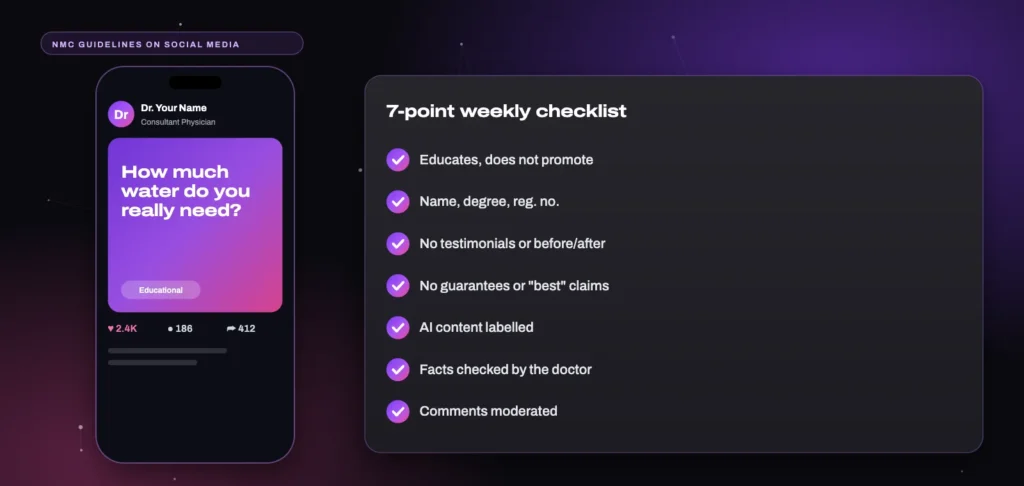
A weekly NMC guidelines checklist you can use
- Is the post educational or factual rather than self-promotional?
- Does it avoid superiority words, guarantees and exaggerated claims?
- Is it free of testimonials, before-and-after images and patient stories used for promotion?
- Does it show the doctor’s name, qualifications and registration number?
- If any part was made with AI, is it labelled?
- If a patient appears or is described, is documented consent on file?
- Has the doctor or hospital approved it before publishing?
Need a second pair of eyes?
If you are unsure how the NMC guidelines apply to your profiles, we can help. We build every client’s social media around these rules, with registration details on every doctor post and client approval before anything goes live. If you would like to know whether your current pages raise any issues, request a free Digital Health Score and we will flag anything that may conflict with the guidelines.
This article is general information, not legal advice. Always refer to the official NMC notice and applicable law.